Laser Coding Machines: Permanent Marking Without Ink or Ribbon
A product code has to stay readable long after the pack leaves the production line. A laser coding machine creates marks by using a focused laser beam to change the surface of a product or package—without ink, ribbon or contact with the product.
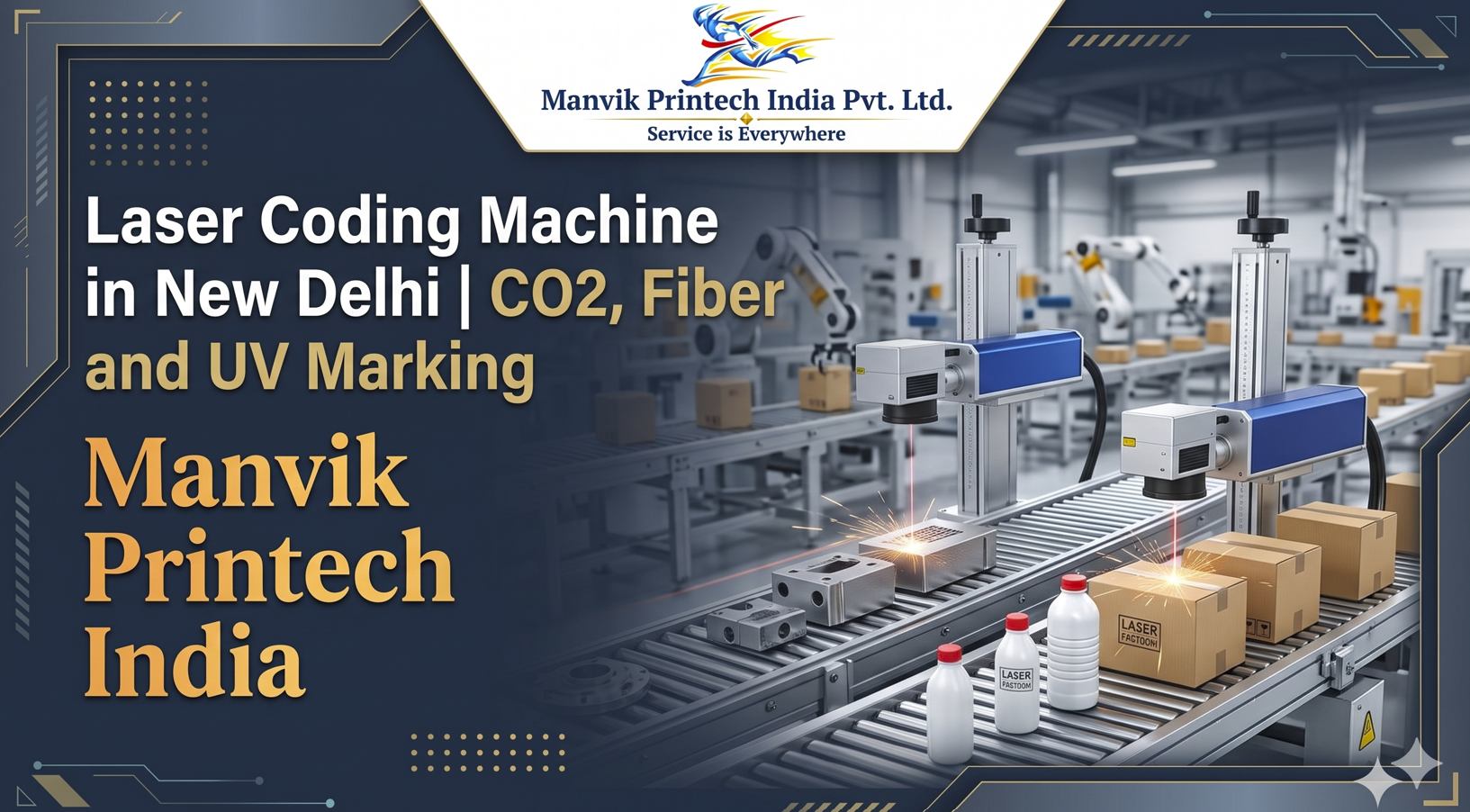
Laser coding can mark batch numbers, dates, serial numbers, logos, barcodes, QR codes and Data Matrix codes. The right laser depends mainly on the material, required contrast and whether the mark needs to be permanent.
What is laser coding?
Laser coding is a non-contact industrial marking process. The laser alters the material surface through processes such as colour change, coating removal or shallow engraving, depending on the material and laser type.
A typical system includes:
- Laser source.
- Marking head and lens.
- Controller and message software.
- Product sensor.
- Conveyor or packaging-line interface.
- Beam protection and safety interlocks.
- Fume extraction or filtration where the application produces fumes or particles.
What can a laser code?
Depending on the laser type and material, a laser coder may mark:
- Manufacturing and expiry dates.
- Batch and lot numbers.
- Product codes.
- Serial numbers.
- Text and logos.
- 1D barcodes.
- QR codes and Data Matrix codes.
- Traceability and identification marks.
The final result depends on the material, colour, coating, message size, production speed, lens and laser configuration.
Types of laser coding machines
CO₂ laser
CO₂ lasers are commonly considered for non-metal materials such as paper, cardboard, glass, wood and selected plastics. They can mark packaging materials such as cartons, labels and certain films, depending on the application.
Fiber laser
Fiber lasers are commonly used for metal and some engineered plastics. They can create high-contrast, durable marks on suitable metal components, nameplates and industrial parts.
UV laser
UV lasers use shorter wavelengths and generally create less heat during marking. This can make them relevant for heat-sensitive materials, selected films, glass and high-value components.
Where are laser coders used?
Laser coding may be evaluated for:
- PET bottles and beverage packaging.
- Pharmaceutical packaging and medical components.
- Food and beverage products.
- Cosmetics packaging.
- Cartons, labels and coated materials.
- Selected flexible films.
- Glass containers.
- Wood and similar organic materials.
- Metal components and industrial parts.
A laser is not automatically suitable for every surface. The material, colour, coating and required mark must be tested before selecting a system.
Why consider laser coding?
No ink or ribbon
The laser creates the mark directly on the product or packaging, so the marking process does not consume ink or ribbon. The system still needs routine inspection, optics care, safety checks and suitable extraction where required.
Non-contact marking
The beam does not touch the product. This can be useful where the surface is delicate, curved or moving continuously.
Permanent marks
Laser marks can be permanent on suitable materials. The durability depends on the material, laser settings and product handling conditions.[videojet]
Digital message changes
Batch numbers, dates, serial numbers and other variable information can be changed through the control software.
Production-line integration
A laser coder can be integrated with a conveyor or packaging line using sensors, encoders, product guides, beam protection, exhaust equipment and safety interlocks.
What to check before buying
Before requesting a quotation, prepare:
- Product or packaging sample.
- Material, colour and coating.
- Required message and mark size.
- Barcode or QR-code scanning requirements.
- Production speed and product spacing.
- Marking location and product orientation.
- Whether the mark must be permanent or removable.
- Exposure to moisture, rubbing, heat or chemicals.
- Available installation space.
- Fume-extraction and safety requirements.
If the application requires a barcode or QR code, test it with the scanner used in production. A code that looks clear may still fail if its size, contrast or quiet zones are not suitable.
Common issues and practical checks
Faint or inconsistent marks
The material, coating, lens or laser settings may not suit the application.
Check: material sample, laser type, lens selection and marking parameters.
Heat damage on sensitive materials
Some plastics, films and coatings can deform or discolour when exposed to heat.
Check: whether a UV laser or adjusted marking settings are more suitable for the material.
Poor barcode or QR-code readability
The code may be too small, low-contrast or distorted by the surface.
Check: code dimensions, contrast, lens, marking speed and scanner compatibility.
Fumes or particles
Some materials release fumes or particles during marking.
Check: suitable extraction or filtration, airflow and maintenance requirements for the application.
Safety requirements
Laser systems require appropriate guarding, interlocks and operator procedures.
Check: beam path, enclosure, interlocks, warning signage and trained-operator access.
Laser versus inkjet coding

The right choice depends on the material, code requirement and production environment—not on which technology is generally considered more advanced.
Laser coding solutions from Manvik Printech India
Manvik Printech India lists CO₂ laser coding systems for permanent, non-contact marking on suitable packaging and product materials. The company also lists fiber laser marking systems for metal applications.
When enquiring, share a product or packaging sample, the required code, production speed and material details. A sample test can help determine whether CO₂, fiber or UV laser marking is suitable.
Why choose Manvik Printech India?
- A coding and marking portfolio that includes CO₂ and fiber laser systems.
- Options for batch numbers, dates, serial numbers, logos, barcodes and QR codes.
- Application discussion covering material, marking area, production speed and line integration.
- A Delhi-based contact point for product and quotation enquiries.
Address and contact details
Manvik Printech India Pvt. Ltd.
First Floor, School Block, S-531-A, Shakarpur Khas Part 2, Block S 2, Upadhyay Block, Laxmi Nagar, Delhi, 110092, India
Phone: +91 99069 05312
Additional phone: +91 88827 65261
Email: ravi.sharma@manviktechnologies.in
Website: manvikprintechindia.com
Working hours: Monday–Saturday, 10:00 AM–6:30 PM; Sunday closed.
Confirm current contact details, product availability and installation support with Manvik Printech India before publishing.
FAQs
Does a laser coding machine need ink?
No. It uses a laser beam to create the mark directly on the product or packaging.
Can a laser coder print QR codes?
Yes, depending on the laser type, material and code size. Test the code with the intended scanner before installation.
Which laser is best for metal?
Fiber lasers are commonly evaluated for metal marking. The material, surface finish and required contrast should be tested.
Which laser is best for packaging?
CO₂ lasers are commonly considered for paper, cardboard, glass and selected plastics. UV lasers may be considered for heat-sensitive materials or selected films.
Is laser coding safe?
Laser systems require appropriate guarding, interlocks and trained operators. Confirm the safety setup and extraction requirements for the specific application.
Keywords