UV Laser Marking Machines: Fine, High-Contrast Marking for Heat-Sensitive Materials
Some products cannot tolerate much heat. Thin films, clear plastics, medical components and delicate electronics can deform, crack or discolour if marked with a high-heat process. A UV laser marking machine uses a short-wavelength ultraviolet beam to create fine, high-contrast marks with minimal heat input—often called cold marking.
UV laser systems typically operate at 355 nm. Because the material absorbs this wavelength photochemically rather than mainly through heat, UV marking can suit applications where charring, melting or micro-cracking must be avoided.
How does UV laser marking work?
A UV laser marking machine focuses a 355 nm beam onto the product surface. The high photon energy can break molecular bonds directly at the surface, producing a mark through photochemical reaction or photoablation rather than relying primarily on heat.
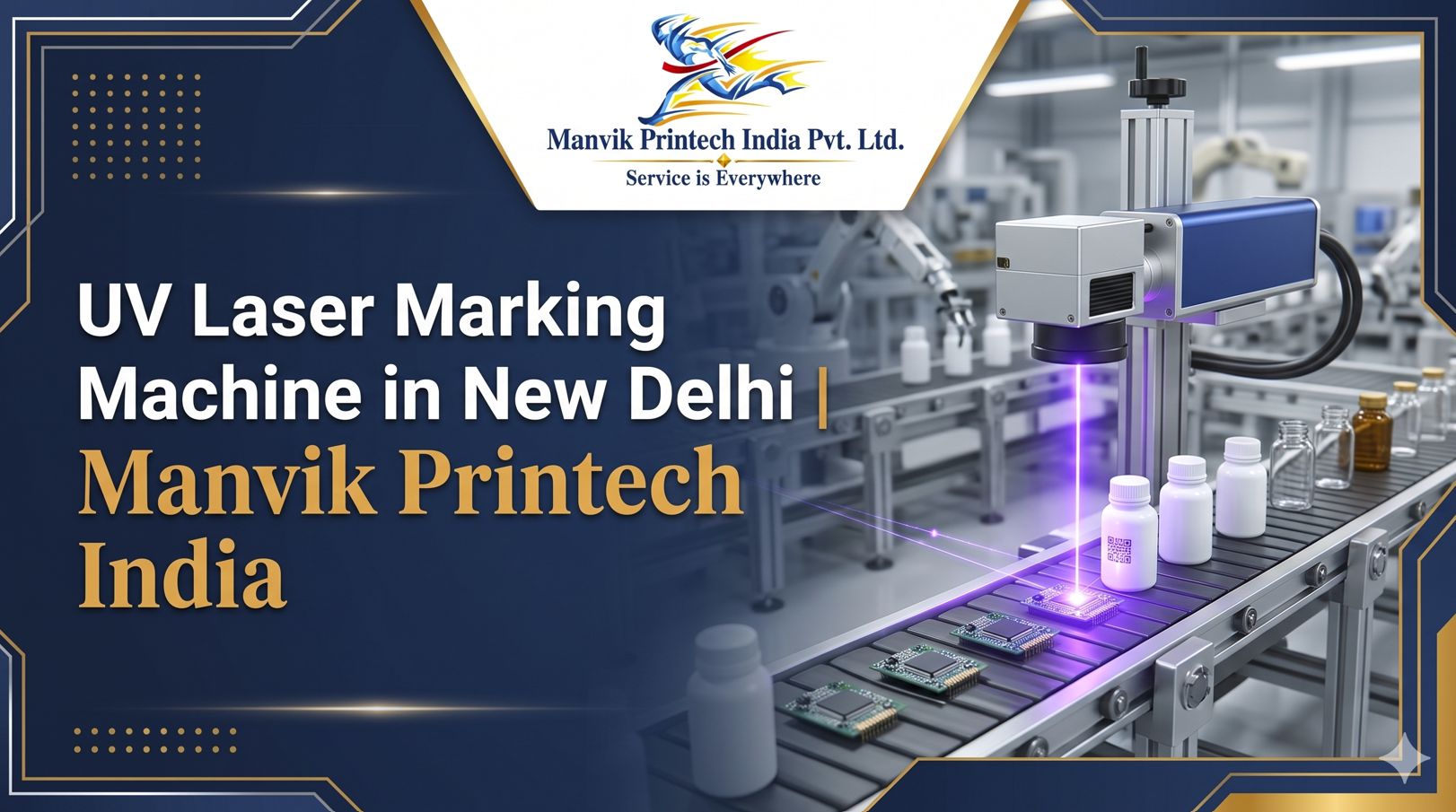
A typical system includes:
- UV laser source.
- Galvanometer scanning head.
- F-theta lens and marking field.
- Controller and marking software.
- Product sensor and trigger.
- Conveyor or packaging-line interface.
- Beam enclosure, interlocks and safety controls.
- Fume extraction or filtration where the material produces fumes or particles .
What can UV lasers mark?
UV lasers may be evaluated for marking on:
- Plastics and polymers, including selected PE, PP and HDPE materials.
- Flexible packaging films.
- Glass and ceramics.
- Medical-device components.
- Electronics and semiconductor-related materials.
- Sealing resins and selected coated surfaces.
- Certain metals and coated metal surfaces, depending on the application.
The result depends on the exact material grade, colour, additive package, coating and surface finish. A UV laser is not automatically suitable for every plastic or transparent material; some clear plastics may absorb UV weakly.
What can it print?
Depending on the configuration, a UV laser can mark:
- Batch and lot numbers.
- Manufacturing and expiry dates.
- Serial numbers.
- Product codes.
- Logos and text.
- 1D barcodes.
- QR codes and Data Matrix codes.
- Traceability and identification marks
For machine-readable codes, confirm the required code size, contrast and scanner. A code that appears clear may still fail if it is too small, lacks contrast or is distorted by the surface.
Why choose UV over other lasers?

UV is often considered when the application needs fine detail, high contrast and minimal thermal stress. Fiber lasers are commonly used for metal, while CO₂ lasers are commonly used for materials such as paper, wood, glass and many plastics.
Where are UV laser markers used?
Packaging and bottles
UV marking may be evaluated for PET bottles, polyethylene and polypropylene packaging, selected films and other compatible materials. It can mark dates, batch numbers and product identification directly on the pack .
Medical and pharmaceutical products
Medical manufacturers may consider UV marking for polymer components, medication bottles and selected devices where a fine, durable mark is needed and heat damage must be minimised.
Electronics
UV lasers can mark sealing resins and selected electronic components without needing to reach deeper internal structures. This can support identification and traceability marking on delicate assemblies.
Glass and ceramics
The short wavelength can produce detailed marks on glass and ceramic surfaces, subject to material testing and lens selection.
Pipes, cables and industrial products
UV systems may be evaluated for HDPE pipes, LLDPE drip laterals, cables and other polymer-based products. The pipe surface, colour, additives and line speed all affect the result.[manvikprintechindia]
What to check before buying
Before requesting a quotation, gather:
- Product or packaging sample.
- Material grade, colour and additives.
- Surface finish and coating.
- Required message and mark size.
- Barcode or QR-code scanning requirement.
- Production speed and product spacing.
- Marking position and product orientation.
- Exposure to rubbing, moisture, heat or chemicals.
- Available installation space and power supply.
- Fume-extraction and safety requirements.
If the application requires a QR code or Data Matrix code, test it with the scanner used in production. A sample test should use the actual product, not only a similar material.
Common issues and practical checks
Faint or inconsistent marks
The material may not absorb UV effectively, or the lens, focus and settings may need adjustment.
Check: material sample, lens selection, focus position and marking parameters.
Heat damage
Even UV marking can affect sensitive materials if power, speed or repetition settings are unsuitable.
Check: laser power, marking speed, pulse settings and material response.
Poor code readability
The code may be too small, low-contrast or affected by surface texture.
Check: code dimensions, contrast, marking area, lens and scanner compatibility.
Fumes or particles
Some materials release fumes or particles during marking.
Check: extraction or filtration, airflow, maintenance schedule and workplace safety requirements.[sourcebyspec]
Safety requirements
UV laser systems require appropriate enclosure, interlocks and trained operators.
Check: beam path, protective housing, warning signage and access control.
UV laser marking from Manvik Printech India
Manvik Printech India lists a UV Laser Printer with a 355 nm wavelength, 3 W, 5 W and 10 W power options, water cooling, automatic operation and a stated marking area of 150 × 150 mm, customisable on request. The listing also states applications including flexible packaging, HDPE, LDPE, PP, metal, HDPE pipes, LLDPE drip laterals and cables.
The company also lists CO₂ laser coding and metal laser marking systems, so an application discussion can help determine whether UV, CO₂ or fiber laser marking is the better match for the material and production requirement.
Why choose Manvik Printech India?
- A UV laser printer option with 355 nm marking and multiple power configurations.
- A coding and marking portfolio that also includes CO₂ and metal laser marking systems.
- Application discussion for packaging, pipes, cables and other product-marking requirements.
- A Delhi-based contact point for product, sample and quotation enquiries.
Address and contact details
Manvik Printech India Pvt. Ltd.
First Floor, School Block, S-531-A, Shakarpur Khas Part 2, Block S 2, Upadhyay Block, Laxmi Nagar, Delhi, 110092, India
Phone: +91 99069 05312
Additional phone: +91 88827 65261
Email: ravi.sharma@manviktechnologies.in
Website: manvikprintechindia.com
Working hours: Monday–Saturday, 10:00 AM–6:30 PM; Sunday closed.
Confirm current specifications, availability, warranty terms and installation support with Manvik Printech India before publishing.
FAQs
What wavelength does a UV laser marking machine use?
Most industrial UV laser markers operate at 355 nm
Why is UV marking called cold marking?
Because the short wavelength can break surface bonds photochemically with relatively little heat, reducing the risk of charring, melting or micro-cracking on suitable materials.
Can UV lasers mark plastic bottles?
They may be suitable for selected plastics and bottles, including some PET, PE and PP materials. The exact material grade and colour must be tested .
Can UV lasers mark metal?
Some UV systems can mark certain metals or coated metal surfaces, but fiber lasers are more commonly considered for bare-metal marking. Test the specific material and required contrast
Can UV laser marks be permanent?
They can be permanent on suitable materials. Durability depends on the material, laser settings and exposure to abrasion, chemicals and environmental conditions
Keywords