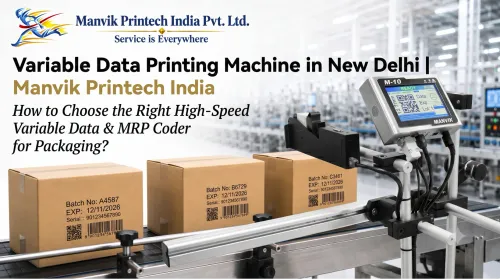
TIJ Machines for Barcode and QR Code Application in New Delhi
If your cartons, labels, or secondary packaging carry barcodes or QR codes that keep failing scans at the retailer, distributor, or pharmacy counter, the fix often isn't your artwork — it's your print resolution. A TIJ (Thermal Inkjet) machine is built exactly for this problem: crisp, cartridge-based, high-resolution coding that MSMEs, pharma companies, and FMCG brands across India rely on for retail-ready, scannable codes. Here's a plain-language guide to what it is, how it works, and when it's the right choice for your line.
Coding Problems That Point to a TIJ Machine
- Barcodes or QR codes rejected by scanners at the pharmacy, retailer, or distribution centre
- Blurry or low-contrast 2D DataMatrix and QR codes that don't hold enough data density to scan cleanly
- CDSCO or GS1 compliance issues on pharma cartons needing serialisation-grade barcode quality
- Frequent maintenance downtime from ink-tank based systems that need regular cleaning
- Messy or complicated printer upkeep that isn't practical in a clean-room or hygienic packaging environment
- Codes that need to carry more than just a date — batch number, MRP, barcode, and logo all in one clean print
- Inconsistent print quality on cartons, labels, and paperboard from older or lower-resolution coding systems
If your business codes cartons or labels for pharma, FMCG, or food & beverage packaging and any of this sounds familiar, a TIJ machine is usually the most direct upgrade.
What Is a TIJ (Thermal Inkjet) Machine?
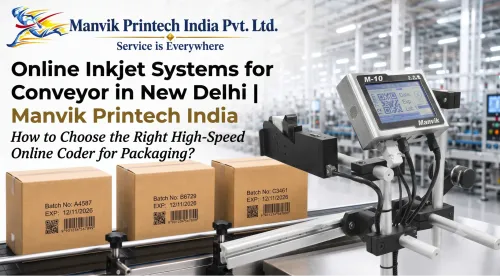
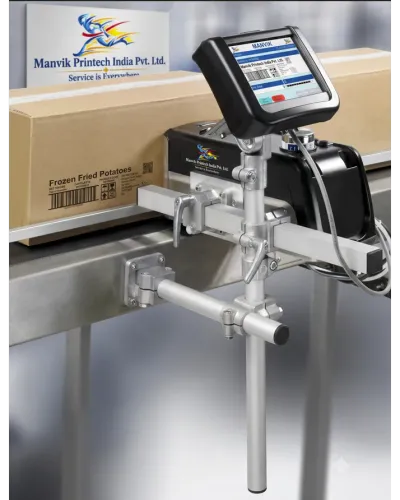
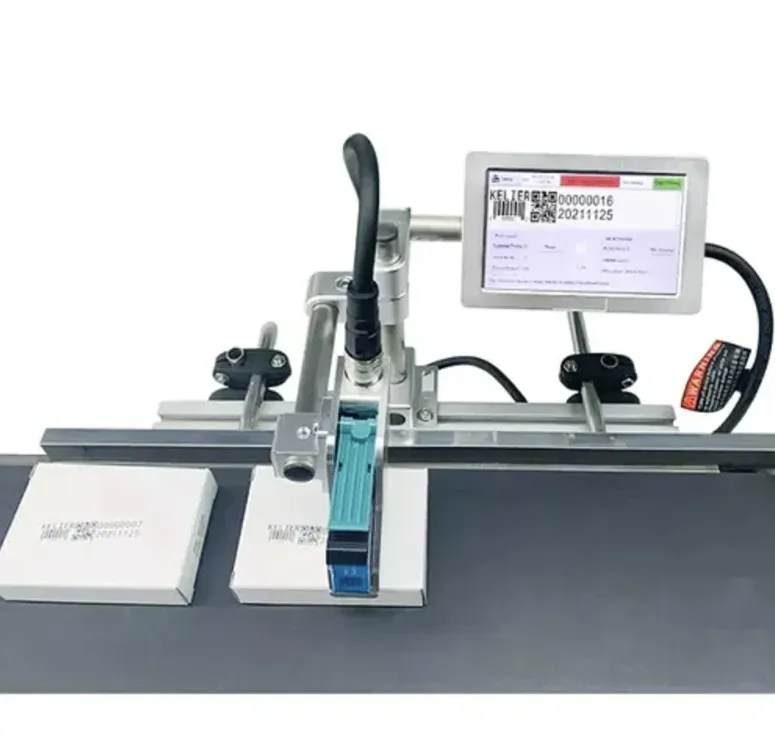
A Thermal Inkjet printer uses heat to fire tiny, precise ink droplets from a sealed, disposable cartridge onto the product surface — similar in principle to an office inkjet printer, but engineered for industrial-grade speed, resolution, and durability. Because the ink system is fully sealed inside the cartridge, there's no ink tank to refill, no solvent to manage, and no messy cleaning cycle — when a cartridge runs low, you simply swap it out.
How TIJ Printing Works
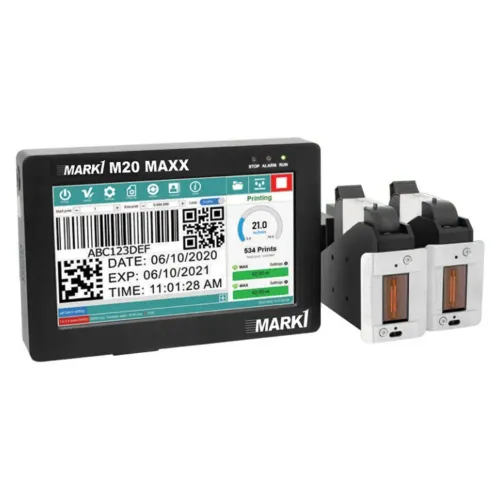
- Content is set: batch number, expiry date, MRP, barcode, QR code, or logo is programmed via a touchscreen or connected software.
- Print head heats selectively: tiny resistors inside the cartridge heat instantly, vaporising a microscopic amount of ink to form a droplet.
- Droplets are fired precisely: each droplet is ejected toward the exact pixel position needed to build sharp text, barcodes, or graphics.
- Fast-drying, high-resolution result: ink dries almost instantly on cartons, labels, and paperboard, producing a clean, scannable code at typical resolutions of 300-600 DPI.
Why TIJ Excels at Barcode and QR Code Printing
- High native resolution — commonly 300 DPI and up to 600 DPI on premium models — sharp enough to render dense 2D DataMatrix and QR codes cleanly
- Consistent, repeatable print quality shift after shift, since there are no wear parts or nozzle-clogging issues common to solvent-based systems
- Clean-room friendly operation — a simple cartridge swap with no ink spillage, well suited to pharma and food packaging environments
- Versatile substrate compatibility — cartons, labels, paperboard, and many plastics and coated surfaces
- Prints more than codes — batch numbers, expiry dates, MRP, serial numbers, logos, and alphanumeric text, all in a single pass
Where MSMEs and Corporates Are Using TIJ Machines
- Pharmaceutical companies: CDSCO-compliant carton serialisation with high-resolution 2D DataMatrix and QR codes
- FMCG brands: outer carton coding with GS1-ready barcodes for retail and distribution
- Food & beverage units: date coding, batch numbers, and QR codes on cartons and labels for traceability
- Cosmetics and personal care: sharp barcode and logo printing on secondary packaging
- E-commerce and logistics: variable data label printing for shipping and inventory tracking
TIJ vs. CIJ vs. TTO — Which Should You Choose?
FactorTIJCIJTTOBest surfaceFlat cartons, labels, paperboardCurved, wet, non-porous surfacesFlexible film, pouches, laminatesPrint resolutionHigh (300-600 DPI)Good, generally lowerHigh (300-600 DPI)MaintenanceMinimal — cartridge swap onlyRegular nozzle cleaningRibbon replacementTypical usePharma/FMCG cartons, labelsBottles, cables, general line codingFFS packaging, flow-wrap, pouches
If your product is coded on flat cartons or labels and you need clean, high-resolution barcodes with minimal maintenance, TIJ is generally the strongest fit. For curved or wet surfaces, CIJ remains the better choice; for flexible film packaging, TTO takes over. Many manufacturers run two or more of these technologies across different lines depending on the packaging format.
Choosing the Right TIJ Machine
- Check your required print resolution — dense 2D barcodes and QR codes need higher DPI than simple date codes.
- Match cartridge ink type to your surface — solvent-based ink works across a wider range of substrates including plastics and coated surfaces.
- Confirm line speed compatibility — verify the printer can keep up with your carton or label line speed.
- Verify local cartridge availability and service support — running out of the right cartridge is one of the most common causes of unplanned downtime.
TIJ Machines — Delhi NCR, Western & Southern India
Manvik Printech India Private Limited supplies, installs, and services TIJ machines alongside CIJ, TTO, handheld, and laser marking printers, serving MSMEs, corporates, pharmaceutical companies, FMCG brands, food & beverage units, and manufacturing plants across Delhi NCR, with support extending to western and southern India. If your barcodes or QR codes are getting rejected on cartons or labels, our team can evaluate your packaging and code requirements to recommend the right TIJ configuration.
Frequently Asked Questions
Can a TIJ machine print QR codes as well as barcodes?
Yes — TIJ's high resolution makes it well suited to both linear barcodes and data-dense 2D QR codes and DataMatrix codes that require finer detail than simple date coding.
Is TIJ suitable for pharmaceutical carton serialisation?
Yes — TIJ is widely used in India for CDSCO-compliant serialisation on pharma cartons, delivering high-resolution 2D DataMatrix and QR codes.
How much maintenance does a TIJ printer need?
TIJ maintenance is minimal compared to ink-tank systems — it typically involves only swapping a sealed cartridge when ink runs low, with no ongoing cleaning or solvent management.
What materials can a TIJ machine print on?
TIJ printers work well on cartons, labels, and paperboard, and with the right solvent-based ink cartridge, can also print on many plastics and coated surfaces.
Where can I buy a TIJ machine in Delhi NCR?
Manvik Printech India Private Limited supplies and services TIJ machines across Delhi NCR, with support extending to western and southern India.
Keywords